

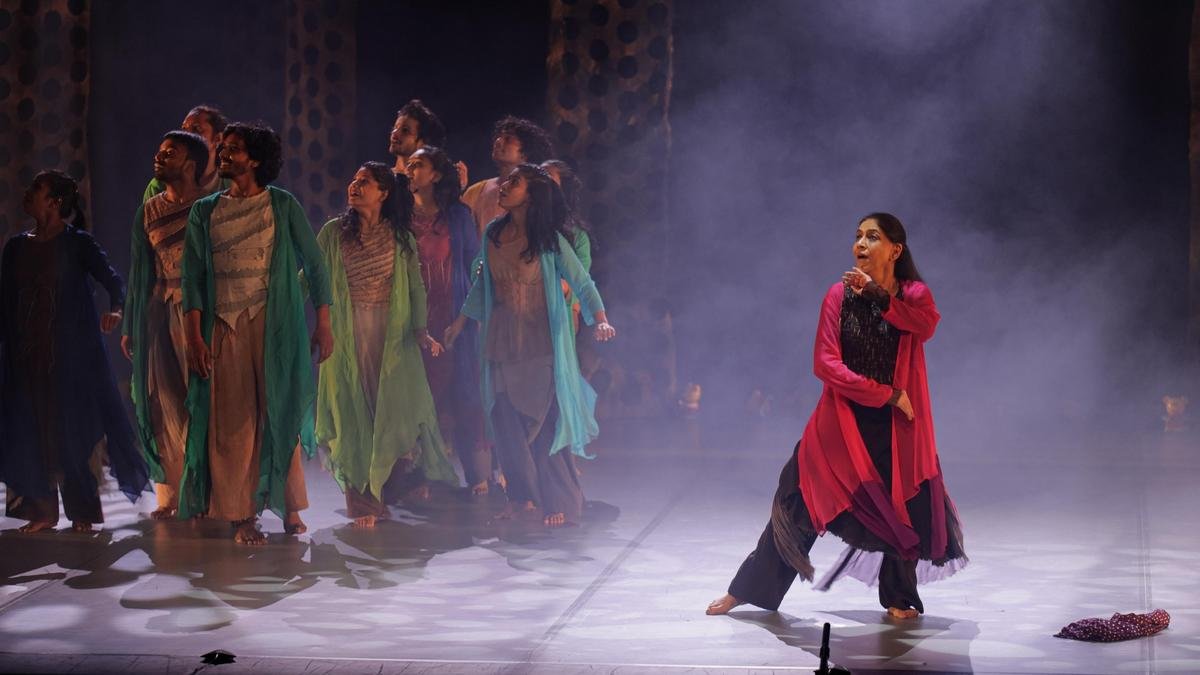
As contemporary Kathak meets a live symphony orchestra for the first time, ‘The Absence of PRESENCE’ explores loss, resilience and the human cost of conflict through movement and music.
Standing on a humid spring evening at the entrance of the Jamshed Bhabha Theatre at the National Centre for the Performing Arts (NCPA), you watch the sun go down over the Arabian Sea, its orange rays shimmering on the water. Perched at the edge of Mumbai’s iconic Marine Drive, the NCPA came up almost 60 years ago on land reclaimed from the sea. As a steady stream of visitors walks in, chatter and laughter fill the spacious foyer, whose neoclassical staircases and tiered crystal chandeliers are reflective of its European-inspired architecture.
When the clock strikes six, the doors to the 1,109-seat proscenium-arch auditorium open for the premiere of Aditi Mangaldas’ ‘The Absence of PRESENCE’. In a first, a contemporary Kathak production unfolds with a live symphony orchestra. The stage is set for a historic collaboration. The 45-member Symphony Orchestra of India (SOI), whose musicians have performed under renowned conductors, including Zubin Mehta, Carlo Rizzi and Sir Mark Elder, is accompanying a dance production for the first time. Led by Melvin Tay, the orchestra occupies the sunken pit by the proscenium, the men in dapper black suits and the women in elegant black gowns. Composer Rushil Ranjan’s score is seamlessly woven into the choreography, creating a rich dialogue between movement and music.
SOURCE: THE HINDU
